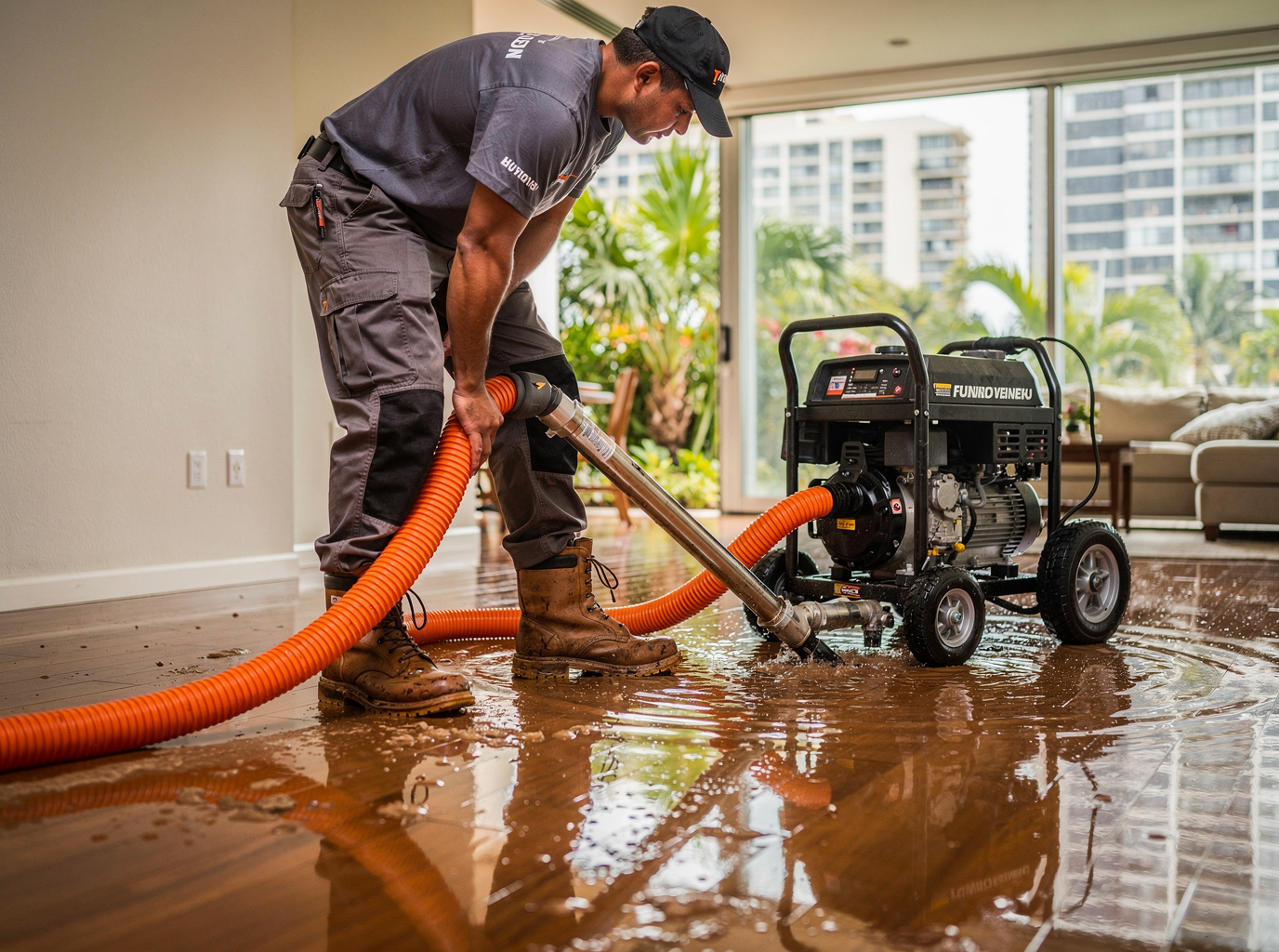
Honolulu’s older housing stock in Nuuanu, Manoa and Kaimuki often features raised wood floors over crawl spaces that trap water after pipe bursts or roof leaks. Trade winds push moisture laterally through these cavities while the lack of a true dry season keeps relative humidity above 60 percent most months, so standing water must be removed within hours rather than days. Technicians use submersible pumps sized for the narrow access points common in 1950s–1970s bungalows, then follow with moisture meters to confirm hidden saturation in the tongue-and-groove subfloors before any drying equipment is placed.
In high-density buildings along Kakaako and Downtown Honolulu, water from upper-floor units travels through concrete slabs and shared walls, reaching units two or three floors below. Emergency crews must coordinate with building management to isolate risers and shut off supply lines without triggering elevator shutdowns that affect dozens of residents. Portable extractors with HEPA filtration are required because many of these mid-rise structures lack exterior hose-bib access, forcing all wastewater to be captured and removed rather than discharged to storm drains near Pearl Harbor.
Waikiki and Alewa Heights properties sit on coral fill or steep slopes that direct runoff into garages and lower levels during heavy showers. Salt-laden water accelerates corrosion of metal lath in plaster walls, so extraction teams document conductivity readings before and after each pass. Failure to remove saline residue leaves efflorescence and hidden corrosion that only appears months later when the next trade-wind storm arrives.
Technician insight
In Honolulu the thing that catches most people out with Emergency Water Removal is how fast our constant humidity and salt air let mold colonize behind baseboards in older wood homes in Nuuanu and Kaimuki; if you wait even one extra day the job doubles because trade winds have already carried moisture into the plaster.
Kakaako High-Rise Leak
Water from a failed supply line on the 12th floor migrated through a concrete slab into two units below. Extraction crews isolated the riser, pumped standing water from both lower units, and used moisture meters to confirm saturation only in the shared wall. Daily drying continued for four days until readings matched unaffected areas.
Emergency Water Removal Services We Offer
✓Burst Pipe Extraction
Immediate pump-out and containment for pressurized line failures common in pre-1980 homes throughout Manoa and Nuuanu.
✓Crawl Space Water Removal
Targeted extraction beneath older Honolulu bungalows where standing water sits against footings and promotes termite activity.
✓Garage Flood Pumping
Rapid removal of runoff that collects in sloped driveways and garages in Alewa Heights and Palolo after heavy showers.
✓High-Rise Unit Extraction
Portable extraction and stairwell transport for water migrating through concrete slabs in Kakaako and Waikiki towers.
✓Appliance Leak Cleanup
Same-day removal of water from failed refrigerators, washers and water heaters in tightly spaced units common in Moiliili and Kalihi.
Emergency Water Removal Cost in Honolulu, HI
| Service | Typical Range | What Affects It |
|---|---|---|
| Initial Extraction Visit | $350–$750 | Higher in Waikiki high-rises due to stairwell transport and after-hours access. |
| Crawl Space Extraction | $400–$900 | Depends on standing depth and debris load common in older Nuuanu and Manoa homes. |
| Multi-Unit Migration Job | $600–$1,400 | Covers tracking water through slabs in Kakaako and Downtown buildings. |
| Daily Monitoring Visit | $125–$225 | Per visit; required until moisture readings stabilize in humid Honolulu climate. |
Ranges are typical for Honolulu, HI and confirmed with an exact written quote before any work starts.
How it works
- 1
Safety And Access Assessment
Crew evaluates electrical hazards, structural access and building-specific shutoffs at the Honolulu address before any equipment enters the structure.
- 2
Standing Water Extraction
Submersible pumps and wet vacuums remove bulk water while containing wastewater for proper disposal away from Honolulu County storm drains.
- 3
Moisture Mapping
Technicians scan walls, floors and ceilings with meters to locate hidden saturation in wood framing typical of local neighborhoods.
- 4
Equipment Placement And Monitoring
Air movers and dehumidifiers are positioned; daily readings track drying progress until levels match pre-loss conditions.
Pricing
Pricing varies by water volume, access difficulty and number of affected levels; most Honolulu jobs fall into the ranges below.