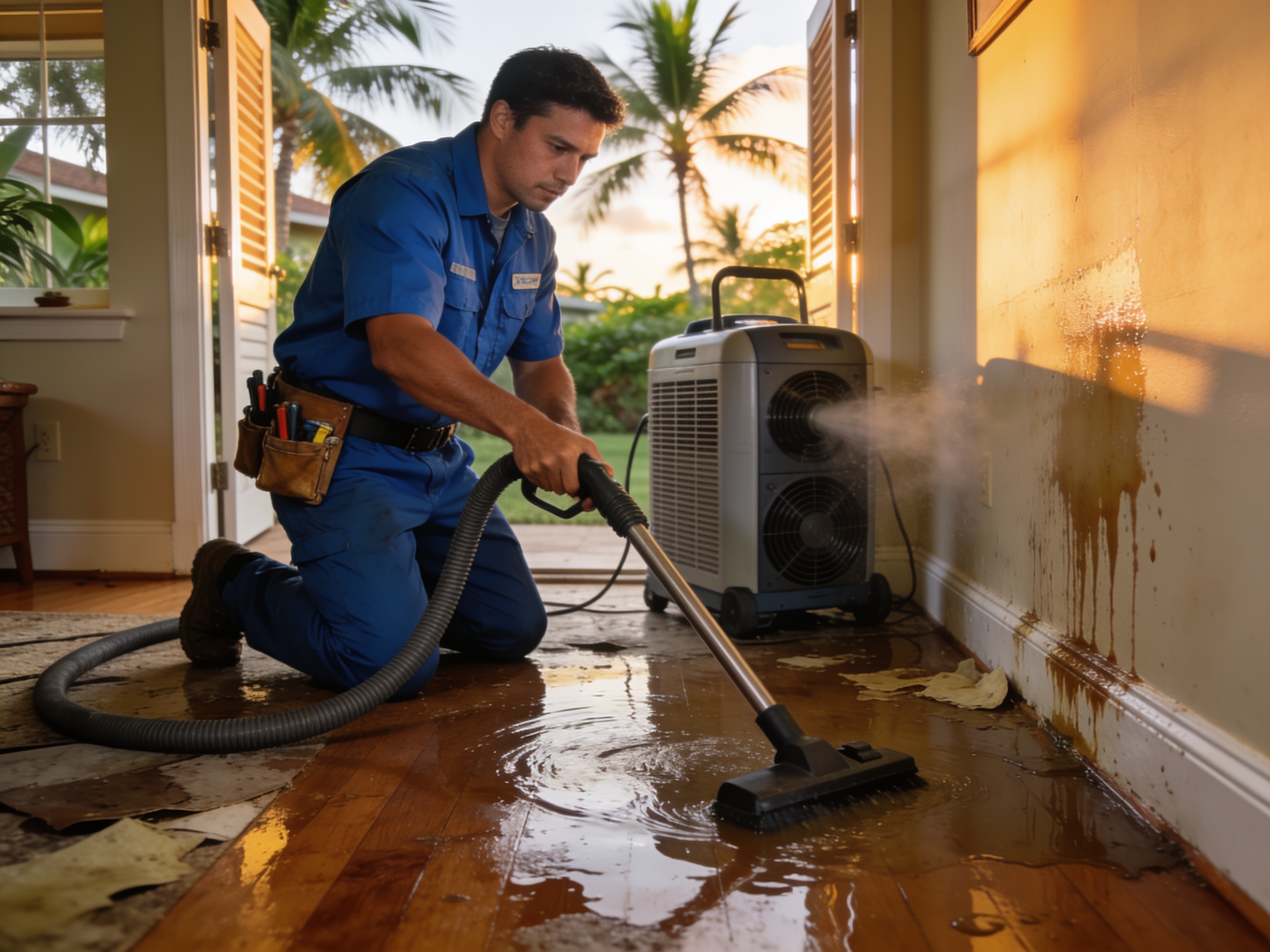
Honolulu's older housing stock in neighborhoods like Nuuanu, Manoa, and Alewa Heights often features single-wall construction and original plumbing that fails during the dry season when trade winds carry salt air inland. These conditions accelerate corrosion in copper lines and create hidden moisture pockets behind tongue-and-groove walls that standard dehumidifiers struggle to reach because of persistent 70-plus percent humidity levels. Crews must pull baseboards early and use directed airflow along with moisture meters to avoid trapped water that later fuels mold in the county's warm temperatures.
In lower-lying areas such as Kakaako, Moiliili, and Kalihi, heavy runoff during rare but intense showers can enter slab-on-grade homes and commercial spaces near Iolani Palace or the Bishop Museum. Extraction here requires pumps rated for brackish water because of proximity to Pearl Harbor and the harbor channel. Technicians also account for the high water table that keeps subfloor moisture elevated long after visible water is removed, extending drying times beyond mainland norms.
Waikiki and Downtown Honolulu high-rises present different challenges with shared plumbing stacks and limited access points. Restoration teams coordinate with building management to isolate units quickly while protecting common corridors from overspray. Because of constant trade winds, equipment placement must include windbreaks to maintain consistent negative pressure and prevent moisture migration into adjacent units.
Restoration in Palolo and Kaimuki often involves post-storm work on older wood-frame homes where roof leaks travel along rafters into interior walls. Local crews prioritize infrared scanning to locate saturation lines before drywall removal, reducing unnecessary demolition in these tightly built lots where neighbor proximity limits staging space.
Technician insight
In Honolulu the thing that catches most people out with water damage restoration is how quickly trade winds push humid air through single-wall homes in places like Manoa or Nuuanu, so what looks dry on the surface can still be saturated behind the boards if you skip the moisture meter step.
Slab Leak in Moiliili Duplex
A pipe failure under a 1960s slab in Moiliili sent water into the living area. Crews found elevated moisture migrating toward the shared wall with the neighboring unit. Extraction and targeted drying prevented spread while preserving the original flooring where possible.
Water Damage Restoration Service Services We Offer
✓Emergency Water Extraction
Rapid removal of standing water from slabs and crawl spaces in humid Honolulu conditions to limit secondary damage before mold sets in.
✓Structural Drying and Dehumidification
Targeted drying protocols that factor in trade winds and year-round humidity to prevent moisture retention in single-wall construction common in Nuuanu and Manoa.
✓Mold Remediation After Water Intrusion
Containment and removal of mold growth triggered by leaks in older Kalihi and Kakaako homes where high ambient moisture delays natural drying.
✓Carpet and Flooring Restoration
Salvage or replacement of flooring materials damaged by flooding or pipe bursts in slab homes throughout Palolo and Moiliili.
✓Drywall and Insulation Removal
Precision demolition of saturated walls in Downtown Honolulu and Waikiki units while protecting adjacent spaces in multi-story buildings.
Water Damage Restoration Service Cost in Honolulu, HI
| Service | Typical Range | What Affects It |
|---|---|---|
| Emergency Extraction Visit | $350–$850 | Depends on volume and whether brackish water or limited access in multi-unit buildings applies. |
| Full Structural Drying | $1,200–$3,500 | Influenced by humidity levels, home age, and number of days equipment must run in trade-wind conditions. |
| Mold Remediation Add-On | $800–$2,800 | Varies with square footage behind walls and containment needs in dense neighborhoods like Kakaako. |
Ranges are typical for Honolulu, HI and confirmed with an exact written quote before any work starts.
How it works
- 1
Initial Assessment
Technician arrives at the Honolulu property and maps moisture levels using meters and thermal imaging while noting neighborhood-specific factors like wind exposure or slab elevation.
- 2
Water Extraction
Standing water is removed with pumps and vacuums suited for local conditions, including any brackish intrusion near Pearl Harbor or the harbor channel.
- 3
Drying and Monitoring
Air movers and dehumidifiers are positioned with windbreaks, then daily moisture readings guide adjustments until levels match pre-loss baselines.
- 4
Repairs and Restoration
Damaged materials are replaced or repaired, with final walkthrough to confirm no residual moisture remains in walls or under flooring.
Pricing
Pricing varies by water category, affected square footage, and access constraints typical in Honolulu's older neighborhoods and high-rises.